


Last month, The New York Times apparently decided that the best way to celebrate Father’s Day was to publish an illustrated piece titled, “To My Daughter, My Gender Was Never Complicated.” It was an astonishing rejection of fatherhood itself. Rather than celebrating fathers, it was about a mother who identifies as a man, suggesting that fatherhood is simply another identity anyone can assume.
The illustrations featured a young girl saying things like, “My dad did it [grew a beard] and he was a girl.” One image showed her asking, “How long did you have breasts for, Dad?” Another showed her looking at photographs of her parent pre-transition, trying to reconcile two entirely different realities.
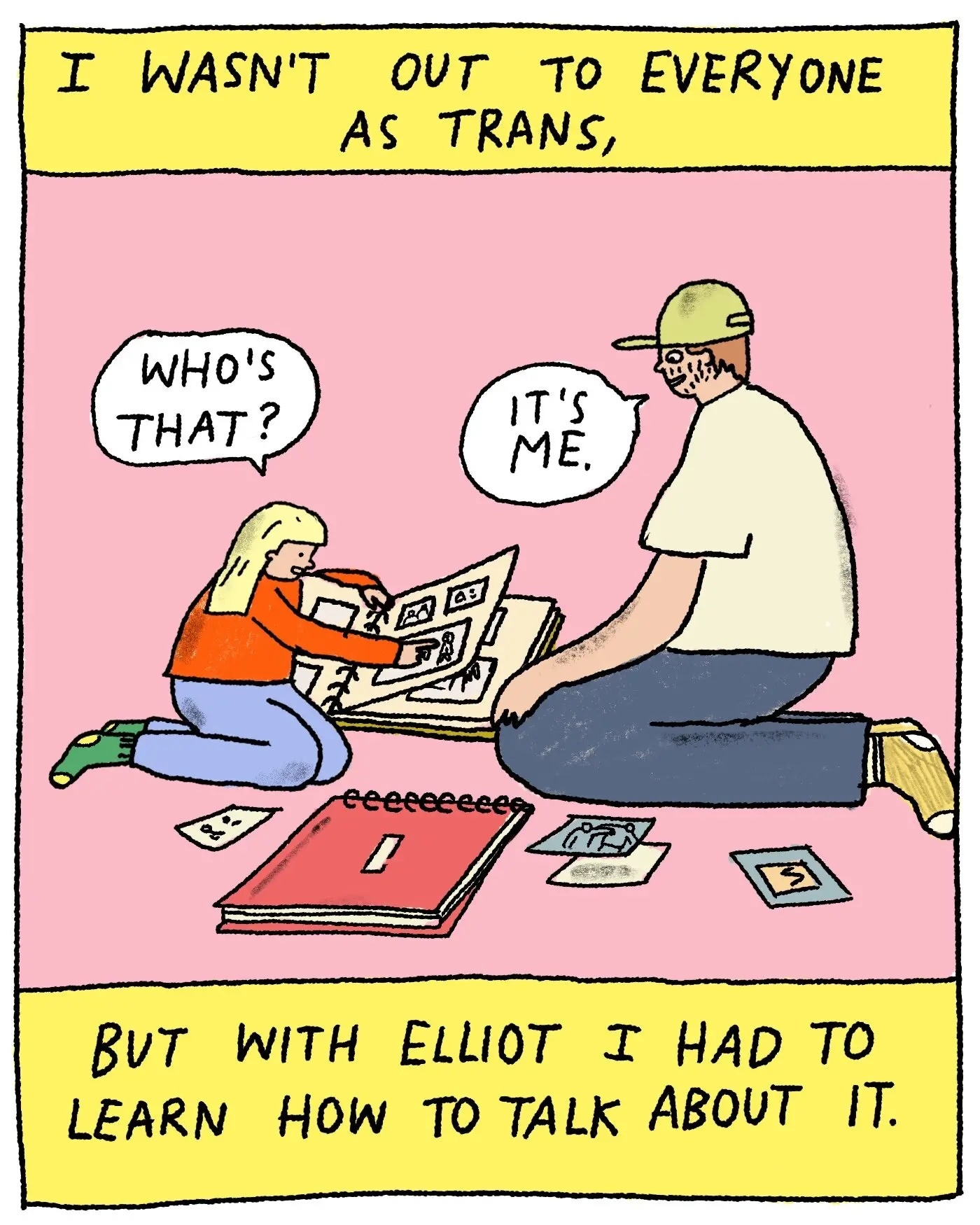
What struck me was not just the rejection of biological reality, but whose emotions mattered. The child’s confusion was treated as something to overcome, while the adult’s identity was treated as something to affirm. The emotional burden rested squarely on the child. Rather than helping the child process an understandably confusing situation, the message was essentially, “This isn’t complicated. Accept it.” The child’s role was to manage the adult’s emotional needs. That is emotional role reversal, not compassion.
We rightfully worry about the harms of transitioning children. We know that it’s harmful to tell a child they were born wrong, to promote the falsehood that a person can change sex, and to lead vulnerable young people down a path of irreversible medicalization. However, trans-identified adults who expect children to affirm their identities cause harm in an entirely different way.
You could argue that this, in fact, is the core problem of modern gender ideology. The movement places extraordinary emphasis on external validation. Pronouns, titles, appearance, and social affirmation are coerced, with children cast as supporting actors in a whimsical performance of an adult’s fake identity.
Perhaps you have already inoculated your child against the idea that he or she was “born in the wrong body.” Even so, it can be hard to shield children from narcissistic adults who expect them to participate in an identity the child can neither understand nor question.
To me, one of the most unsettling dynamics is when children in captive environments, like classrooms, family gatherings, churches, or community groups, are used to validate an adult’s sense of self. These situations invert the healthy adult-child relationship. Suddenly, it’s the child’s responsibility to manage the adult’s emotions.
The child is no longer free to simply be a child. Instead, he or she becomes a vessel for an adult’s emotional validation. Children should never be expected to carry the emotional burden of making adults feel secure about themselves. Developmentally, children do not understand abstract concepts like gender identity. They understand what they see. When adults insist they deny obvious reality in order to protect someone else’s feelings, children are left confused, demoralized, and emotionally destabilized.
As troubling as this is, it becomes even darker when you consider what these interactions teach children. From an early age, children are told to “be kind” and “be inclusive.” Applied correctly, those are admirable values. But when those slogans are twisted to encourage children to ignore reality and suppress their own discomfort, they take on an entirely different meaning. The message becomes: ignore your instincts, ignore your questions, and protect the adult’s feelings at all costs. Rewarding children for denying what they plainly observe is a dangerous lesson to teach.
Children need to learn appropriate empathy, but not at the expense of trusting their own perceptions. Teaching them to suppress discomfort in order to satisfy adults leaves them more vulnerable to manipulation. Children who learn that good kids ignore their instincts are children who may struggle to recognize unhealthy situations later in life.
Children deserve adults who provide stability, guidance, and protection, not adults who depend on children for emotional reassurance. Father’s Day should be about honoring fathers and the unique role they play in their children’s lives. Instead, one of America’s most influential newspapers chose to celebrate an ideology that blurs and even inverts those roles.
Teach your children kindness. Teach them compassion. But also teach them that genuine kindness never requires that they deny reality, suppress their own perceptions, or carry emotional burdens that belong to adults. That is a weight no child should ever be asked to bear.

Truth and common sense. And I can’t imagine the NYT ever publishing a rebuttal like this.
Very well said. I healed from satanic ritual abuse I’d sustained as a child. The last area to address was physical. The first was spiritual, the second was my mind. I was then prepared to deal with my emotions more deeply. And then I zeroed in on maximizing my physical health. The entire process was a faith walk because I believed I should have life and that more abundant. I followed Jesus out of this darkness. He knew me better than I knew myself.
I appreciate that you have focused the light on the innocent child of an emotionally sick parent and affirmed their needs and the truth of the damage that can be caused.
Wise analysis - too bad your article wasn’t on the front page of the New York Times. That’s where it belonged.